
Banned News · Health & money
Warren Buffett called it class warfare. The Fed tracks who owns the wealth.
Buffett’s interview gives the argument in his own words. The Fed’s household accounts let readers test what “winning” would mean in dollars.
Warren Buffett told CNN in 2011 that his class had been winning what he called class warfare. He was making an argument about taxes and economic power from inside the wealthiest group. In a separate Yahoo Finance interview, shown here, Buffett addressed how capitalism affects the income gap.
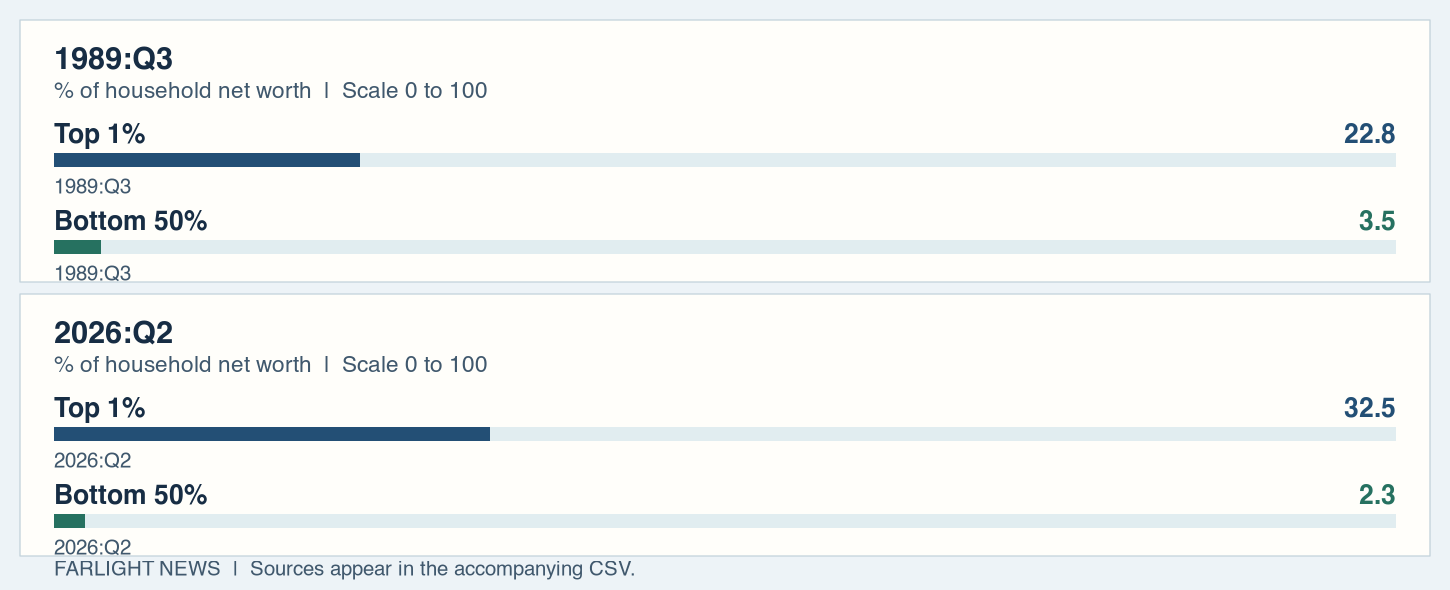
The Federal Reserve’s Distributional Financial Accounts report how household wealth is divided. Their top groups, middle groups and bottom half use an explicit definition of net worth. A household can earn a high income and owe substantial debt, or hold valuable assets with relatively little taxable income. In the Fed’s second-quarter 2026 series, the top 1% held 32.5% of household net worth. The bottom half held 2.3%.
The first check for a chart about who benefited is its denominator. A rising dollar amount can coexist with a falling share of total wealth. Use the Fed’s share series to measure concentration, then look at separate tax data before assigning the movement to tax policy.
Who holds U.S. household net worth?
The top 1% sums the Fed’s two highest groups. The bottom 50% is the Fed’s published value. Calculations use rounded inputs.
1989:Q3
% of household net worth · 0–100
-
Top 1%22.8%
1989:Q3
-
Bottom 50%3.5%
1989:Q3
2026:Q2
% of household net worth · 0–100
-
Top 1%32.5%
2026:Q2
-
Bottom 50%2.3%
2026:Q2
Data and sources
Watch the exchanges
Sources
Read next
Banned News · Health & money
The U.S. spends about 2.5 times the 29-country European benchmark, while life expectancy is shorter and avoidable mortality is higher.

Banned News · Health & money
The president shared the gold-card pitch and said he would meet its author. A meeting, an endorsement and a bill are three different milestones.